What a Personal Information Affidavit Can and Cannot Do
A personal information affidavit is a sworn statement you prepare and file yourself to put data brokers and institutions on notice. It works as one layer of a removal and monitoring program, not as a one-time fix.
By the Area 52 team
7 min read

A personal information affidavit is a sworn statement you draft, sign, and deliver yourself to put a specific data broker or institution on formal notice about specific records, and it works as one layer of a removal and monitoring program rather than as a one-time fix. The document changes the terms of a removal request: it converts an informal ask into a dated, attributable claim of identity. That shift is the entire return on the work.
What a Sworn Notice Document Actually Does
An affidavit is a sworn factual declaration, not a legal order, and the distance between those two things is where its real value sits. You are asserting, under penalty of perjury in most jurisdictions, that the identifying data attached to a record set is yours and that the record set is wrong, outdated, or published without a lawful basis. Whoever receives it now holds a signed claim from a named person with a delivery date attached.
It serves two audiences. The first is the broker, people-search operator, or institution holding the record. The second is your own future self, because a signed instrument with a receipt attached is the evidence you reach for when a complaint, a demand letter, or an internal escalation needs a starting point.
Notice is not deletion. Clearing an address from a people-search index and keeping it cleared are different tasks, and the affidavit only touches the first one. The removal itself still runs through broker opt-out procedures and search-engine delisting channels, which is why requesting removal from Google search belongs in the same program as the filing rather than instead of it.
The Tests That Separate a Usable Document From a Decorative One
A receiving department will triage your document in seconds. Four things decide whether it lands in a removal queue or a recycling bin.
| Criterion | What to check | Why it matters |
|---|---|---|
| Record specificity | Does each entry name the exact field, URL, or account the claim covers? | Generic "my information" language gives the recipient nothing to act on |
| Identity continuity | Do the identifiers in the affidavit match the identifiers in the record, including former names and prior addresses? | A mismatch lets the recipient reject the claim as unverified |
| Delivery proof | Is there a dated receipt, tracking number, or delivery confirmation? | Without it you cannot establish a response clock |
| Demand clarity | Does the document state what action you want, field by field? | Recipients act on instructions, not grievances |
Read the broker's own opt-out page before you write a word, and note what it will and will not suppress. The FTC's consumer guidance on people search sites makes the limit plain: these platforms let you opt out of sharing certain types of information, like your address or phone number, but not other information, like sex offender status (FTC Consumer Advice). An affidavit demanding the impossible reads to the recipient as uninformed, and uninformed filings get delayed.
The stakes behind the paperwork are concrete. The same FTC guidance warns that if someone has just one piece of information about you, such as your name or phone number, a people search site can sell a report revealing your age, previous addresses, marital status, and the names and addresses of your family members. That aggregation is what you are documenting, record by record. Understanding what free removal tools actually delete also tells you which residues to name in your claim.
Drafting and Delivering the Notice, Step by Step
The mechanism is simple and unforgiving: an affidavit works in proportion to how little it asks the recipient to interpret.
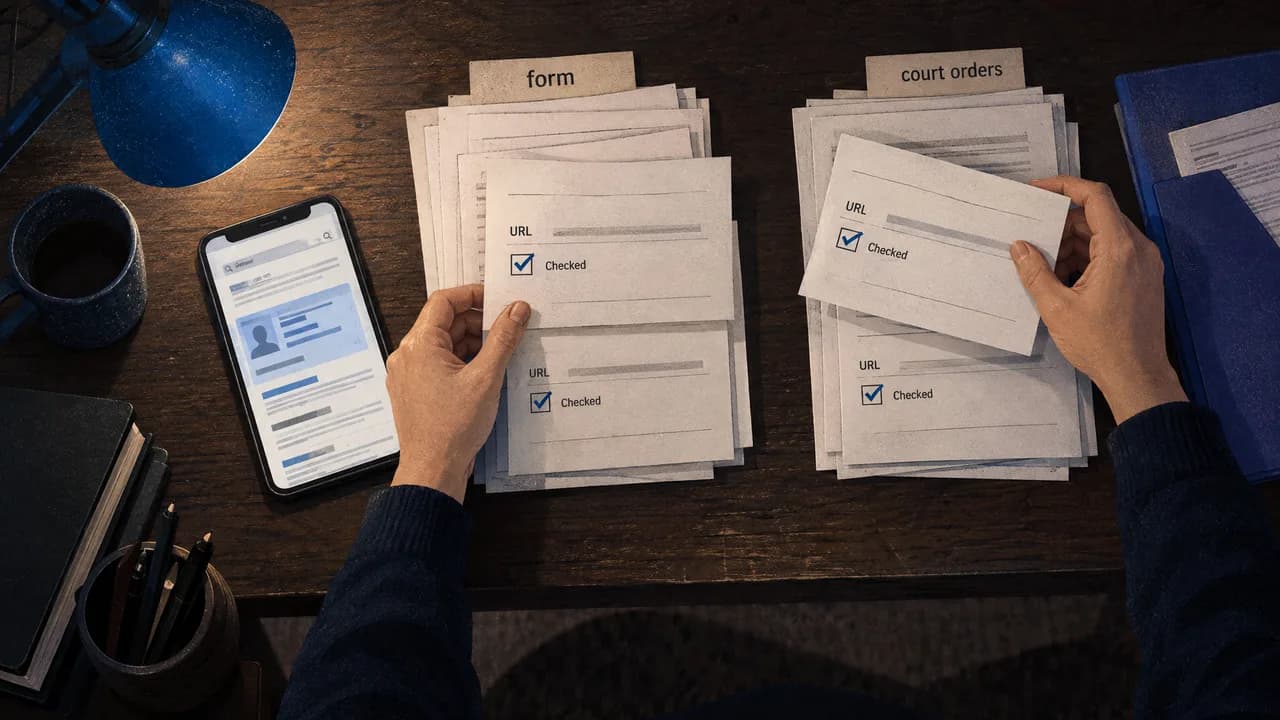
- Build a factual inventory. Screenshot each record with its URL, capture the date, and save the captures somewhere you control. This inventory becomes the exhibit list and the factual core of the claim.
- Identify the recipient's legal entity and the correct notice address. A filing sent to a marketing inbox is a filing that never happened.
- Write the declaration in plain declarative sentences: who you are, what identifiers the record carries, which fields are inaccurate or published without basis, and what action you want taken. Attach the inventory as exhibits.
- Execute the document with the formality its recipient expects. Where notarization is required or requested, get it.
- Deliver it with proof. Keep the receipt with the document.
- Calendar the follow-up before you send anything. If the recipient responds with a verification request, answer within days, not weeks. A stalled verification is the most common place these filings die.
Think of the whole sequence as supplying an audit trail rather than producing a verdict. Each step above hands the next step something it cannot work without: the inventory defines the demand, the demand defines what the receipt proves, and the receipt defines when your follow-up clock starts. Skip any link and the chain breaks at that point.
Signals That Tell You to File Now
You are the right person to file when you can name the records, name the holder, and describe the harm in factual terms. Those three conditions met, a signed declaration is a reasonable next move and costs you mostly time.
The decision shifts when the exposure touches your household rather than just you. A record set that includes family names, prior addresses, and relationship details is not a private inconvenience; it is a map. Executives and public-facing principals usually discover at this point that a filing alone leaves the household perimeter unmanaged, and that is where a broader program of suppression and monitoring earns its place.
Ask whether the document will be read by a regulator, a counterparty, or a court. If yes, the drafting standard rises and professional review before signing is the sensible call. If the recipient is a broker opt-out desk, a tight factual statement with exhibits is enough.
The timing question also turns on where you sit jurisdictionally. Boards and executives tracking statutory duties should map their information protection obligations before deciding how aggressive to be with notice documents, because the filing and the underlying regime interact.
Where Well-Intentioned Filings Go Wrong
The most expensive mistake is treating the signature as the finish line. A notarized document that lands in a broker's queue removes nothing by itself; the record persists until the recipient processes it and until the source that republished it is dealt with separately. Build the removal work into the same calendar as the filing, or you will hold a receipt and an unchanged search result.
Overclaiming in the body of the declaration creates its own problem. Statements about what the recipient has done, why they did it, or what the law compels them to do invite a dispute you did not need, and every disputed assertion delays the fields you actually wanted cleared. Stick to what you can prove with an exhibit.
Conflating a private notice document with a statutory instrument happens more than it should. Filing an affidavit under your own name is not the same as invoking a formal complaint process or a regulator's procedure, and recipients who spot the confusion will route the document to legal review instead of a removal queue. Know which vehicle you are using.
Naming too many recipients in a single document feels efficient and usually backfires. One record set, one holder, one declaration. Bulk filings blur the factual specificity that makes each claim actionable, and they make follow-up tracking unmanageable.
Treating the draft as reusable boilerplate is the quiet failure. Templates circulate widely and recipients recognize them. A declaration that reads like everyone's is easier to defer than one that names a specific URL and a specific wrong field.
If you want the exposure cleared across broker databases, search indexes, and the open web while the paperwork runs its course, our team works the removal side directly. Reach us at greyman@a52.io or +15712102227 to talk through scope.
Frequently Asked Questions
Can I do an affidavit myself?
Yes, in the ordinary sense: you can draft, sign, and deliver a factual declaration about your own records without engaging anyone. The work that makes it effective is preparation, not paperwork, so the inventory and the delivery proof matter more than the wording. Where the recipient is a regulator or the document may be read in a legal proceeding, have a professional review the draft before you sign it.
What is a personal affidavit?
It is a written statement of fact that the signer swears is true, executed with whatever formality the receiving party requires. In this context the facts are about your identity and the records attached to it. It functions as notice with a name and a date on it, not as an order that compels anyone to act.
What not to say in an affidavit?
Leave out conclusions about motive, legal characterizations you cannot support, and anything you have not personally verified. Do not bundle unrelated record sets or multiple recipients into one document. Avoid promising outcomes or describing what the recipient must do as a matter of law unless a cited authority backs it. Every sentence you cannot defend with an exhibit is a sentence that gives the recipient a reason to pause.
Can I print my own affidavit?
Printing and signing your own document is normal practice. What matters is that the execution matches the recipient's expectations: a wet signature, a notary stamp where one is required or requested, and exhibits attached in order. Keep a complete signed copy and the delivery receipt together, because that pair is what turns a printout into evidence.
Get new articles by email
New articles from Area 52, sent to your inbox.
By subscribing you agree to receive emails from Area 52 about new articles. You can unsubscribe at any time.