Area 52 dark web monitoring for executives: find exposure, then close it
Dark web monitoring only pays off when detection is wired to removal and a rehearsed response. Alerts alone leave the exposure sitting there.
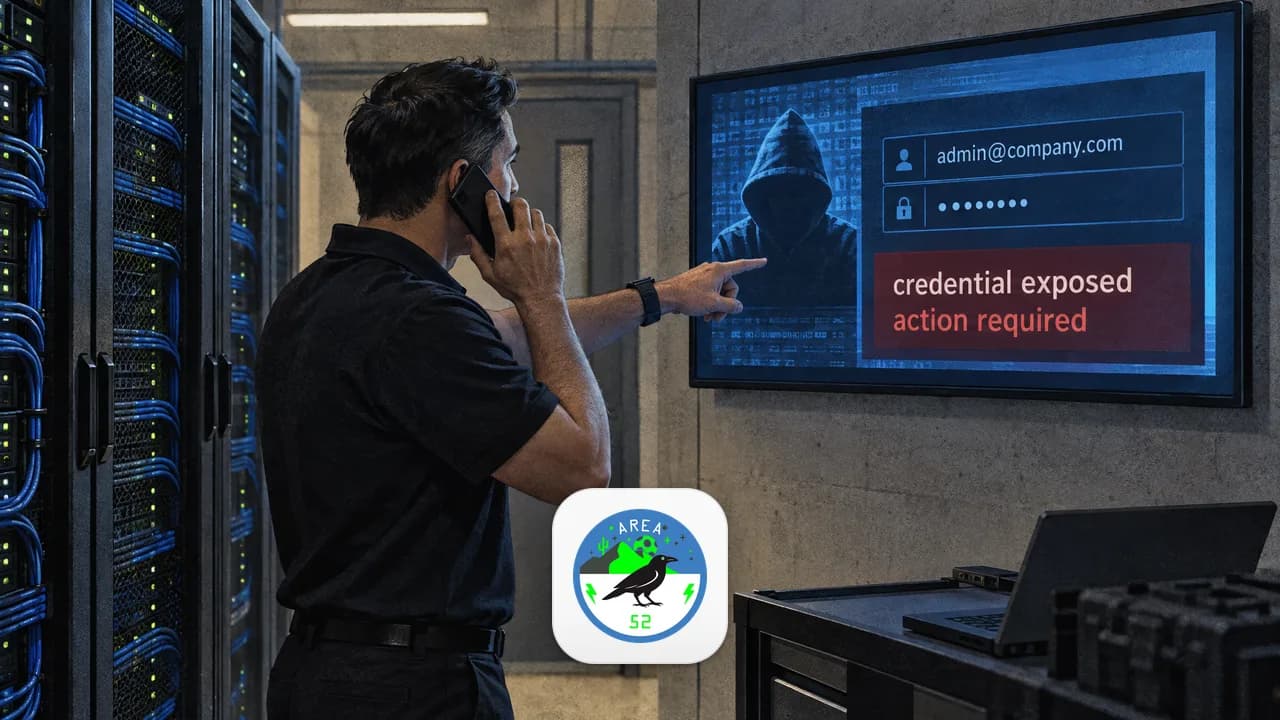
Dark web monitoring finds your exposed credentials and personal data in criminal marketplaces, then hands you the alert; protection decides what happens in the hour after. Area 52 provides dark web monitoring as one feature inside an executive digital protection service.
A feed that flags an exposure and stops there has handed you a to-do list, not protection. The credential is still live, the listing is still up, and the buyer who paid for it already has what they wanted. Monitoring earns its budget only when detection is wired to removal and to a response that runs before the attacker converts the access into a loss.
Dark Web Monitoring Is Collection, Not a Cleanup Service
Dark web monitoring is the continuous collection and analysis of stolen data from criminal marketplaces, paste sites, and private forums, matched against the identifiers you own. It is intelligence gathering, not a removal service, and conflating the two is where most budgets leak.
The work has a documented research base. The goal is not a verdict about whether your data is out there. It already is. The goal is knowing which record matters today, because an old breach dump and a live set of credentials for the email tied to your banking require entirely different responses.
The concept is often mistaken for three adjacent tools. Credit monitoring watches financial accounts and tells you after fraud occurs. Identity theft protection watches your credit file for new accounts opened in your name. Dark web monitoring watches the sources criminals use to trade access before any of that shows up. That timing gap is the whole point: early warning beats cleanup, and a program built around the wrong one always reacts to damage instead of preventing it.
Who it serves is narrower than the market admits. An executive whose name appears in filings, whose personal email is the recovery address for corporate systems, and whose family shares their surname and home network is a fundamentally different monitoring subject than an anonymous consumer. The same service, applied to both, is either overbuilt or underbuilt, never right.
How Continuous Collection Turns Stolen Data Into Evidence
Collection runs in layers. A crawler set works the visible criminal web: marketplaces where credentials are sold in bulk, paste sites where dumps are posted for free, and forums where specific individuals get discussed by name. Analysts then work the closed sources, where access requires a Tor browser and credentials the operators themselves issued. The U.S. Department of Justice notes that accessing these forums using legitimate credentials provided by their operators is the best way to avoid legal exposure (justice.gov). The collection side carries real legal discipline.
Matching is the step that separates signal from noise. Analysts take the identifiers under monitoring, work and personal email addresses, usernames, phone numbers, and domain credentials, and run them against what the crawl retrieved. Most hits are false positives: a shared name, a recyclable credential pattern, an old email alias that has been dead for years.
What follows is not a PDF. A useful alert names the source, the date the data appeared, the identifier that matched, and what the exposed credential still unlocks today. That last part is what a reader decides on.
The endpoint of detection is a file of exposure evidence: which record, where it surfaced, when, and what it authenticates. That file becomes the input for removal, credential resets, and suppression requests. A program that stops at detection holds the evidence and never files the case, which is why a program that actually works carries the response steps in the same workflow as the scans.
Building an Exposure Response Routine
- Inventory every identifier tied to your name and your household: work email, personal email, recovery addresses, phone numbers, usernames, and domain accounts.
- Place all of them under continuous monitoring rather than running a one-time scan, since an exposure recorded today can be reused months later.
- Assign one named person who owns the alert queue and has the authority to act on it within the hour.
- On every confirmed hit, change the credential first, before you investigate scope, and rotate it everywhere it was reused.
- Pull the exposed record from data broker aggregators, since a broker listing keeps the same data available to the next buyer after the breach post is gone.
- Log response time per incident and review it monthly, because a program is judged by the minutes between alert and action.
- Re-scan the identifier after removal to confirm the exposure is no longer discoverable at the source.
The order matters more than the individual steps. Readers who reverse steps four and five, removing broker listings before rotating credentials, spend effort hiding data that is still active somewhere else. Move the credential first; clean the surface second.
Criteria That Separate Real Coverage From a Demo
Judge any provider against these, and demand evidence for each rather than a description of the capability.
| Criterion | What to check |
|---|---|
| Identifier scope | Does coverage include family members, personal email, and home identity, or stop at the corporate mailbox? |
| Source coverage | Which forums, marketplaces, and paste sites are actually crawled, and how often? |
| Alert content | Does the alert name the source, the credential, and what it still unlocks, or send a generic breach notification? |
| Removal service | Is the exposed record removed from broker aggregators, or does the program only report it? |
| Legal handling | How does the collector access closed forums, and does that method stay inside the DOJ guidance on authorization? |
| Named owner | Is there one person accountable for acting on alerts, or a shared inbox nobody owns? |
A structure for a monitoring program covers scope, sources, and ownership together, because each one fails separately and takes the others down with it.
Two categories of provider exist opposite each other. Platform vendors manage personal digital risk across the executive's personal footprint. Those are real capabilities with a different center of gravity. A program that measures itself on response time and owns the removal step will out-perform one that measures itself on coverage volume, even where the coverage volume is genuinely larger.
Errors That Leave You Exposed Anyway
Treating monitoring as a report instead of a program. Buyers subscribe, receive a breach notification, change one password, and never return to the queue. The exposure sits there. The credential gets reused. The next alert is an aftermath report.
Ignoring the personal identity because the corporate system is locked down. The corporate mailbox is the hardened surface. The personal email is the recovery address for everything, the spouse's account shares the surname, and the home network carries the smart locks. Coverage that stops at the office is a perimeter drawn around the wrong building. This is exactly why response speed matters more than the type of need: need dark web monitoring, or don't, and the deciding variable is whether someone acts in minutes or after the weekend.
Buying on coverage volume alone. A vendor claiming the largest number of sources may still send alerts that name nothing you can act on. Ask what a real alert contains before the contract, not after.
Filing no removal requests. Removing a broker listing takes repeated contact and proof of identity, and it does not happen because you subscribed. A subscription without removal is a subscription to bad news.
Letting legal questions stop the response. Exposure to a stolen credential is not a crime committed against you that you must report before acting. Reset the credential, then decide who gets told.
Deciding When Monitoring Moves From Optional to Necessary
You cross a threshold the moment your name is the asset. If an attacker can use your identity to reach a board, a client, or a wire transfer, your personal digital footprint is a business risk whether or not your title says executive. The signal that settles it is not the size of your company. It is whether one compromised credential at home opens something at work.
Consider the counterfactual. If your recovery email is compromised tonight, how many systems can be reset tomorrow morning before anyone notices, and who would notice? If the answer is a vague and the owner is a shared inbox, monitoring is not optional. If the answer is a named person and a rehearsed step, you may already have what a monitoring subscription promises, and you should be honest about that rather than buying the alert feed twice.
What each outcome means going forward is the harder question. A program that detects an exposure and cannot act on it has told you something true and made you no safer. A program that detects, removes, and rotates makes the same discovery an operational event with a defined end. Choose which one you are buying.
Inside Our Monitoring and Response Practice
We provide dark web monitoring as part of a protection service, paired with data broker removal, OSINT, vulnerability scans, penetration testing, and suppression of damaging content. The monitoring is the detection layer; the removal and response layers are what keep the exposure from being reused. That combination, reputation management and cybersecurity under one engagement, is the second reason clients stay.
The principal reason is that a dedicated Digital Guard is assigned per client, so the person reading the alert owns what happens next. There is no queue you have to work yourself. When a credential surfaces in a marketplace listing, the response runs through a named owner, and the exposed record gets removed from the aggregator that was reselling it.
A reader with a single mailbox and no name exposure does not need this. If your digital surface is one personal email account with no board seat, no public filings, and no money movement attached to your name, a consumer tool is a defensible choice, and we will tell you so. The service is sized for a person whose compromised identity can move an organization.
We work from McLean, Virginia. Reach the team at greyman@a52.io, +15712102227, or 1350 Beverly Road, STE 115, PMB 175, McLean, Virginia 22101.
Frequently Asked Questions
Is dark web monitoring legit?
The collection and analysis side is a documented practice with a research base, and the alerts reflect real data retrieved from criminal sources. The claim that deserves scrutiny is the one about outcomes, because a provider that detects exposure and stops leaves the record in place. Legitimacy is decided by what happens after the alert: whether the credential is rotated, whether the exposed record is removed from broker aggregators, and whether a named person owns the response. Monitoring that stops at detection is a real capability sold as a complete one.
What does a dark web monitoring alert actually tell me?
A useful alert names the source where the data appeared, the date it surfaced, the identifier that matched, and what the exposed credential still unlocks today. That last field is the one you act on, because an old credential for a dead alias needs nothing and a live credential for your recovery address needs a reset within the hour. An alert that only says your email was found in a breach is a notification, not intelligence, and it forces you to reconstruct the scope yourself.
Do I need monitoring if my company already has security tools?
Corporate tools protect the corporate perimeter, which is not where most executive exposure lives. Your recovery email, personal phone number, family accounts, and home network sit outside that perimeter, and a compromise there can reach the systems your company protects. The question is not whether your company monitors. It is whether anyone watches the identifiers tied to your name personally, and whether they can act on a hit within minutes rather than at the next quarterly review.
What happens after the first confirmed exposure?
The credential rotation comes first, before any investigation of scope, and it happens everywhere the credential was reused. The exposed record then gets pulled from data broker aggregators, since a broker listing keeps the same data available to the next buyer long after the original post is gone. The incident gets logged with its response time, and the identifier is re-scanned to confirm the exposure is no longer discoverable at the source. That sequence, repeated, is what a monitoring program is.
Sources
- justice.gov
Accessing forums using legitimate credentials provided by forum operators is the best way of avoiding legal issues concerning the means of access.
Sources checked on October 7, 2026.
Get new articles by email
New articles from Area 52, sent to your inbox.
By subscribing you agree to receive emails from Area 52 about new articles. You can unsubscribe at any time.