The Information Warfare Definition That Misses the Point for Executives
Most information warfare definitions stop at cyberattacks, missing the psychological targeting that actually harms executives. Here is the definition you need, why consensus is thin, and what defense looks like.

The information warfare definition that matters is not about hacking; it is about using information as a weapon to change what you believe, decide, and do. An information warfare definition that serves an executive describes a campaign of coordinated actions, using falsehoods, stolen data, and psychological pressure, to manipulate a target's decisions without their awareness. That framing matters because it shifts the threat from an IT problem to a leadership problem, and it is the only framing that explains why the sharpest technical defenses still lose.
Most published definitions never get that far. The Congressional Research Service says there is currently no official U.S. government definition of information warfare (CRS report). The University of Washington's Jackson School describes it as a struggle to control or deny the confidentiality, integrity, and availability of information in all its forms (Jackson School). Both are accurate. Neither tells an executive what to do on Monday morning.
What the Term Actually Covers
The academic literature has spent three decades trying to pin this down, and the result is instructive precisely because consensus never arrived.
That lack of settled meaning is not a failure. It is the tell. When a concept resists definition for thirty years, the disagreement itself is the content. Information warfare is broad because its subject, information, is broad. The Wikipedia definition calls information the interpretation of that which may be sensed, or their abstractions (Wikipedia, Information). If your raw material is all of human perception, your doctrine resists neat boundaries.
For an executive, the practical consequence is that any working definition must be wider than cyber. It must include the manipulated board decks, the planted rumors in trade press, the fabricated earnings call transcripts, and the social media campaign aimed at your shareholders. Those are not adjacent to the threat. They are the threat. A definition that centers on hacking misses the attack surface that actually harms leaders.
How Information Warfare Operates in Practice
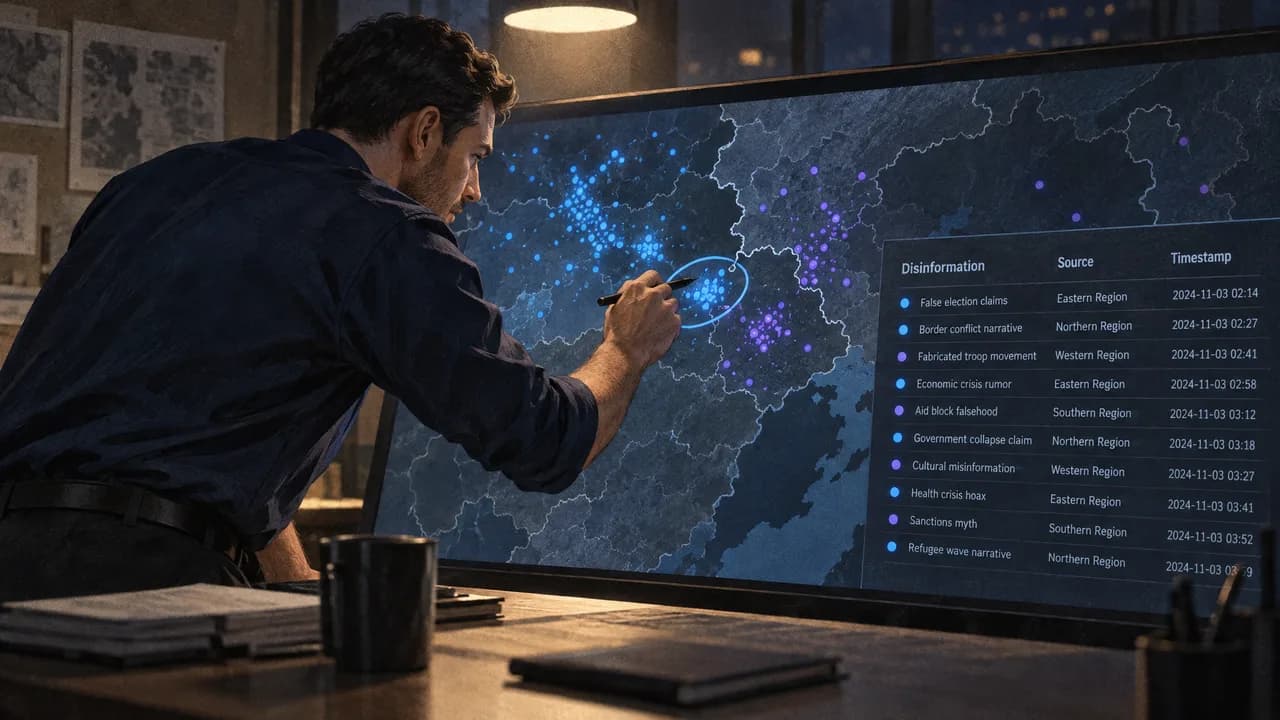
Information warfare works in layers, and the first layer is almost never technical. It starts with intelligence collection: assembling a dossier on the target from public records, data broker listings, leaked databases, and social media. This is why our digital footprint checker free scan framing exists: the free scan the attacker runs is not a favor, it is the reconnaissance phase.
The second layer is content manipulation. The attacker fabricates or alters information that the target or their stakeholders will trust: a manipulated photograph, a forged email, a synthetic audio clip, a fake news article designed to look like a legitimate outlet. The weaponized content is then amplified through bot networks, coordinated accounts, or a willing press cycle.
The third layer is the psychological one, and this is where the definition matters. The campaign's objective is to change a decision. It works by exhausting the target, seeding doubt among their board, or manufacturing a narrative that forces a defensive response. The attacker does not need to win the argument. They need to consume your attention, your credibility, and your time.
This layered structure is why the term keeps colliding with hybrid warfare. Information warfare is the information component of that blend, and it is often the cheapest component an adversary can deploy.
The mechanism, reduced to its essentials, is simple: collect, fabricate, amplify, exploit. The defense, reduced to its essentials, is equally simple: find the threat first, and take it off the board. That is the core of what we do. We find it first, and take it off the board. The detection, the suppression, the amplification of your own positive content, all of it is downstream of that single commitment.
A Working Framework for Analyzing Threats
A practical analysis framework needs four moves, and each move depends on the one before it, so a true ordered sequence is the honest shape here.
- Establish a baseline of your digital footprint. Inventory what data brokers, people-search sites, and public records hold against your name, your family's names, and your addresses. You cannot detect a manipulation campaign if you do not know what the truth already looks like.
- Monitor for change and fabrication. Track dark web forums, compromised credential lists, and deep web chatter for mentions of your name or your company's leadership. This is the dark web monitoring for executives function, and it is a detection capability, not a reporting service.
- Analyze the intent of what you find. A leaked password is a cyber event. A leaked password combined with a planted rumor about your company's solvency is an information warfare event. The difference is the presence of a coordinated narrative.
- Act to suppress and counter. File removal requests against data broker listings, suppress defamatory content from search results, and produce positive content that outranks the attack. This is the step most defense programs skip because it is labor-intensive and unglamorous.
Each step produces the input for the next. Without the baseline, monitoring has nothing to compare. Without monitoring, analysis has no data. Without analysis, action is blind.
How to Evaluate a Defense Program
When you evaluate any information warfare defense, whether ours or another firm's, the dimensions below are what actually separate a real capability from a monitoring dashboard that will never be read.
- Coverage scope. Does the program cover your spouse, your children, and your addresses, or only your corporate email? The gap between "executive covered" and "household covered" is where the most damaging attacks land. Our guide to data broker suppression for high-net-worth individuals exists because that gap is routinely ignored.
- Detection source depth. Is the monitoring limited to indexed web results, or does it include dark web forums and credential dumps? Surface-level monitoring catches only the sloppy attacks.
- Response capability. What happens when something is found? A report that lands in your inbox is not a defense. The firm needs the ability to act: to file suppressions, to push removal requests, to create content that buries the attack.
- Human judgment. Is there a person who interprets the findings, or do you get an automated feed? A dedicated analyst who knows your profile is the difference between a threat assessment and a data dump.
- Speed of action. The half-life of a targeted rumor is short. The firm must be able to act in hours, not weeks.
The trade-off most buyers miss is between breadth and depth. A program that covers everything superficially will miss the one targeted attack that matters. A program that understands your specific exposure can catch it, but it requires the firm to actually know your profile, which is why we assign a dedicated Digital Guard to every client.
Where Most Defense Strategies Go Wrong
The most common failure is treating information warfare as an IT problem. Organizations buy a firewall, a monitoring tool, and a breach response plan, and call it defense. That posture misses the entire psychological layer. If the adversary's target is your board's confidence, no firewall helps.
A second failure is the one-scan mentality. Executives run a single data broker removal sweep, declare victory, and move on. That pattern is not a bug in the service they chose. It is a fundamental misunderstanding of what data removal actually requires. The brokers re-list. The search results re-rank. The attack surface rebuilds itself. If you treat it as a one-time task, you are not protecting yourself; you are just cleaning one shelf in a store that restocks every night.
A third failure is ignoring the family. The information warfare playbook targets the executive through the spouse, the children, and the household staff because those accounts are less defended. A program that covers only the principal leaves the soft perimeter exposed.
A fourth failure is passivity after an incident. Many executives respond to an attack by deleting social media and going quiet. That is a surrender of the information space. The correct response is to amplify positive content and regain control of the narrative, which is exactly what our content creation and amplification features support.
Deciding When to Act
You do not need a full defense program if your role carries no public visibility and your personal information is not indexed anywhere.
You do need one if any of these signals are present: your name appears on people-search sites, your immediate family has a public footprint, you hold a role where a credibility attack would move markets or board opinion, or you have already seen a coordinated rumor about you or your company.
The strongest signal is the coordination itself. One negative review is noise. A same-day cluster of negative posts across platforms, pushed by accounts with no history, is a campaign. When you see that pattern, the time for evaluation is over. You act immediately, and you act with a firm that can move on all fronts at once: suppression, monitoring, and positive content.
There is a cost to acting, and it is real. But the cost of not acting is a fabricated narrative that outranks the real one in search results for years. We have watched too many executives learn this after the fact to stay quiet about it. If you want a clearer picture of what the full engagement looks like, our buying guide for choosing a digital protection firm walks through the decision in detail.
Frequently Asked Questions
What are some examples of information warfare?
Recent examples of information warfare follow a consistent pattern. A campaign may fabricate a manipulated video of a CEO making a damaging statement, then push it through bot networks to force a stock sell-off. Another example is the coordinated leak of an executive's personal data, combined with planting rumors of infidelity or insolvency, designed to trigger a board challenge. A third is the sustained harassment of family members on social media to pressure an executive into a decision. Each shares the same anatomy: collect intelligence, weaponize content, amplify it, and exploit the target's reaction. The technical vector varies; the psychological objective does not.
What are the four types of warfare?
The "four types" framing usually refers to a taxonomy of conflict domains: conventional warfare, irregular warfare, cyber warfare, and information warfare. In practice, these overlap rather than sit in neat boxes. Information warfare frequently operates as the enabling layer for the other three, softening a target before a conventional or cyber action, or replacing kinetic action entirely when a psychological outcome suffices. The taxonomy is useful as a mental model, but treating the categories as sealed compartments underestimates how adversaries combine them.
What is the difference between information warfare and cognitive warfare?
Information warfare targets the information itself and the systems that carry it. Cognitive warfare targets the human processing of that information, the beliefs, biases, and decision-making patterns that determine an executive's choices. The distinction is between attacking the message and attacking the mind. Information warfare might deface a website or delete a database. The same operation becomes cognitive warfare when it aims to change what a leader believes about their own company's stability. In practice the two are inseparable: nearly all information warfare has a cognitive objective, and almost no cognitive warfare proceeds without manipulating information.
Sources
- jsis.washington.edu
Information Warfare (IW) is a struggle to control or deny the confidentiality, integrity, and availability of information in all its forms, ranging from raw data to complex concepts and ideas.
- Information on Wikipedia
At the most fundamental level, it pertains to the interpretation (perhaps formally) of that which may be sensed, or their abstractions.
Sources checked on August 18, 2026.
Get new articles by email
New articles from Area 52, sent to your inbox.
By subscribing you agree to receive emails from Area 52 about new articles. You can unsubscribe at any time.