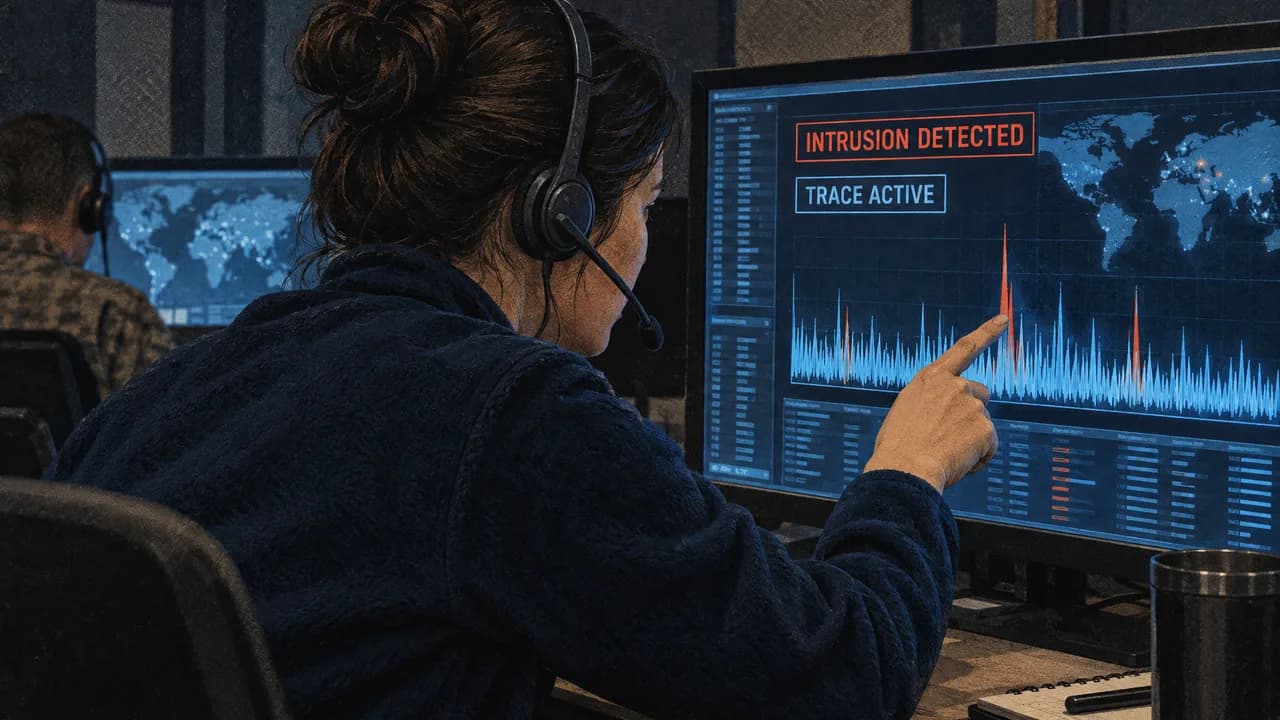
Information warfare NATO: How the Alliance Fights It
NATO's information warfare work is a defense-in-depth model, not a news story. Here is what the alliance actually does, and the criteria and mistakes that decide whether your own approach holds.
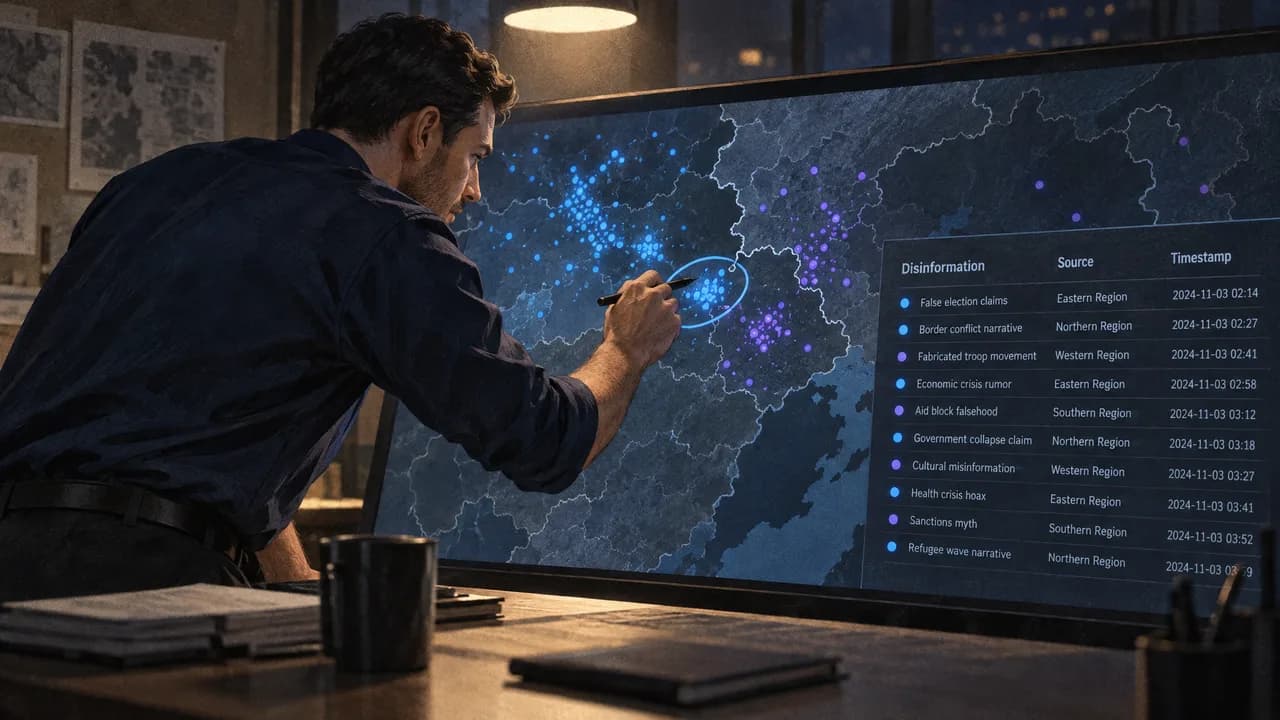
NATO's answer to information warfare is institutional persistence: the alliance built standing structures that treat influence defense as a permanent condition, not a crisis to staff after the fact. That is the transferable lesson, and it is the one most executive briefings skip. Copy the structure (an owner, a cadence, a boundary, a written playbook) and the technology question mostly answers itself.
Bold: What the Alliance Actually Runs, and What It Leaves Out
The information warfare definition worth working from is not about weapons at all: it is the organized contest over what a target audience believes, decides, and repeats, fought across channels that were never designed as battlefields. One university program describes the setting precisely as the information environment, "the aggregate of individuals, organizations, and systems that collect, process, disseminate, or act on information" (jsis.washington.edu). NATO operates inside that environment, and so does your company.
What sits inside the lane: elections, procurement decisions, alliance cohesion, public trust in institutions, the perceived legitimacy of a defense budget line. What sits outside it: the kinetic end of conflict, and the purely technical breach. A network intrusion is a means, not the subject. The subject is what people do afterward.
That distinction carries real weight for an executive because it moves the target. If the contest is over belief and decision, the asset at risk is not a server. It is the credibility of the leadership team, the reliability of the company's public record, and the confidence of the board. For a fuller working definition of information warfare, the alliance framing is the useful starting point, not the label itself.
Reading the Doctrine: Criteria That Separate Real Defense From Paper
Most organizations evaluating their own posture check for tools. Check for these instead, since each one is observable and each one predicts whether the discipline survives a bad quarter.
| Criterion | What to inspect | What a weak answer looks like |
|---|---|---|
| Ownership | A named person and a named deputy, not a committee | "The CISO handles it" with no deputy and no charter |
| Mandate | Written scope covering personal identities, not just corporate assets | Coverage that stops at the work email account |
| Cadence | A recurring production rhythm: monitoring, publication, review | Activity only when something goes wrong |
| Decision boundary | A pre-agreed rule for who authorizes what response, at what speed | Escalation to the executive suite for every event |
| Evidence trail | Logged collection, retention, and a written record of prior takedowns | No visibility into what is already circulating |
The U.S. Army's Cyber Defense Review, in a 2021 article, framed the umbrella term this way: information advantage activities include employing capabilities to enable decision-making, protect friendly information, inform and educate domestic audiences, inform and influence international audiences, and conduct information warfare (Cyber Defense Review). Read that list slowly.
Only the last item is offensive. Four of the five are protective and communicative. That ratio is the criterion most private-sector readers miss, and it is why a program built entirely around attack tooling is mispriced. For a comparable view from the private sector, see the definition that actually holds up for executive audiences.
How the Doctrine Actually Moves: Assignment, Cadence, Boundary, Playbook
The alliance model works because it converts an abstract contest into four assignable actions, and each one produces the input the next one needs. Run them in order; skipping ahead leaves the later ones hollow.
- Assign a single owner to the discipline and give that owner a charter that includes the executive's personal footprint, the family's accounts, and the company's public record. One owner, one deputy, written scope.
- Set a monitoring cadence and hold it, including the quiet weeks, producing a short written read of what is circulating about the leadership team and through which channels.
- Pre-agree the decision boundary: which findings the owner resolves alone, which require an executive decision, and which trigger outside counsel or a specialist engagement.
- Rehearse the response once while nothing is on fire, including the removal request path, the holding statement, and the internal notification order.
- Feed what the rehearsal exposed back into the charter and the cadence, which is how the discipline compounds instead of resetting each year.
The mechanism underneath is simple. Persistent structures generate their own intelligence: a standing team sees a narrative building in week two because someone was watching in week two. A crisis team first learns about it in week six, when the narrative has hardened and the response options have narrowed. That is not a resource gap. It is a timing gap, and timing gaps are structural.
NATO also operates under constraints no private company faces, which is why copying the shape beats copying the content. Defense-sector information work runs inside a distinct set of parameters shaped by national security imperatives and geopolitical considerations rather than by consumer-protection and privacy rules, as a European Defence Agency white paper on trust and AI in defence describes (European Defence Agency). Your constraints are different. The structures that survive those constraints look similar anyway.
A note on where the pressure actually appears: the alliance's posture matters commercially because contested narratives move procurement decisions, export approvals, and executive reputations. Running the recent examples pattern against your own leadership team is the fastest way to see which version of the problem you already have.
Your Decision: Copy the Structure or Buy the Crash Response
You face a fork, and it is not the one the vendor market presents. The real question is whether you want to own the monitoring rhythm internally or transfer it to a firm that runs it as a standing function. Both are defensible. They cost differently and fail differently.
Copy the structure internally if you already have a security function with spare analytical capacity, a leader who will personally hold the cadence, and a tolerance for the first year being mostly setup. The trade-off is honest: you will spend that first year building collection and relationships, and you will learn what you missed by missing it once.
Transfer the function when the exposure is concentrated in a small number of named people, when a board or a deal timeline makes a public incident unusually expensive, or when no one internally can hold a weekly rhythm through a busy quarter. That is the situation where a dedicated guard assigned per client beats a general-purpose tool: attention is the scarce resource, not software.
What settles it is one question. If a hostile narrative about your CEO were seeded tomorrow, who would notice first, and how long until they told someone with authority to act? Name the person and the number of hours. If you cannot, the structure is the gap, not the tooling. When you want that read from outside the building, reach us at greyman@a52.io or +1 571-210-2227, or write to 1350 Beverly Road, STE 115, PMB 175, McLean, Virginia 22101.
Four Confusions Worth Naming
Treating the whole discipline as offensive is the first and most expensive confusion. Executives read the threat reporting, conclude the topic is about someone else's attack capability, and file it away. The 2021 Cyber Defense Review breakdown above shows what that reading costs: four of its five information advantage activities are defensive and communicative. Reframe the topic around what you protect and whom you inform, and the budget conversation changes.
Confusing an incident with a campaign follows close behind. One article, one impersonation account, one viral post is an incident. Executives respond to incidents with a takedown and a statement. A campaign is a sequence with a thesis, and it requires a different cadence of response: patience, publication, and repetition. The tell is whether the material keeps arriving after you address the first wave.
Believing that monitoring equals defense wastes real money. A monitoring subscription that produces alerts nobody acts on is a receipt, not a posture. The Army's framing, repeated in press commentary, notes that information warfare has become mainstream enough that aspects of it are reported routinely in the national press (Australian Army Research Centre). Mainstream coverage is not a substitute for your own collection, and alerts are not a substitute for a decision path.
Assumed coverage is the quiet one. Teams audit the corporate perimeter and call the job done, while the same executive's personal email, family accounts, and decade-old records sit entirely unowned. Test this with a five-minute question: list every digital identity tied to each senior leader, then check which ones appear in anyone's monitoring scope. The gap between those two lists is your real exposure, and it is usually larger than the tooling budget suggests.
Frequently Asked Questions
What are some examples of information warfare?
Election interference operations, coordinated disinformation around a military procurement decision, impersonation accounts targeting a public figure, hack-and-leak campaigns, and state-aligned narratives aimed at undermining trust in an alliance or institution. The 2021 Cyber Defense Review article lists information advantage activities that include informing and influencing international audiences alongside conducting information warfare. The common thread is not the channel. It is the attempt to change what an audience believes and how it decides.
What is information warfare?
It is the organized use of information to alter what key audiences believe and how they decide, conducted inside the information environment: the aggregate of individuals, organizations, and systems that collect, process, disseminate, or act on information. It spans collecting intelligence, protecting your own information, publishing to shape perception, and contesting an adversary's narrative. It does not require a network intrusion to succeed. Changing what a board, a customer, or a regulator believes is enough.
What is an example of cognitive warfare?
Cognitive warfare targets how people think rather than what they know, exploiting cognitive biases, emotional triggers, and repetition to shift judgment at scale. A realistic version is a sustained campaign that pairs a true fragment of an executive's record with a false framing, seeded across channels over months until the framing becomes the default assumption. The mechanism is volume and repetition, not a single decisive post. Defending against it means watching narrative drift over time, not just scanning for a breach.
What is the definition of information warfare?
The working definition is the organized contest over what a target audience believes, decides, and repeats, fought across channels that were never designed as battlefields. The U.S. Army's 2021 Cyber Defense Review places it inside the broader term information advantage, which also covers enabling decision-making, protecting friendly information, and informing domestic and international audiences. The definition matters because it sets the target: belief and decision rather than infrastructure.
Sources
Sources checked on September 28, 2026.
Get new articles by email
New articles from Area 52, sent to your inbox.
By subscribing you agree to receive emails from Area 52 about new articles. You can unsubscribe at any time.