Information Warfare for Executives Explained: The Defense Starts Before the Attack
Information warfare targets executive reputation and decision-making, not just networks. Most executives defend the wrong layer, and the gap is where real damage happens.
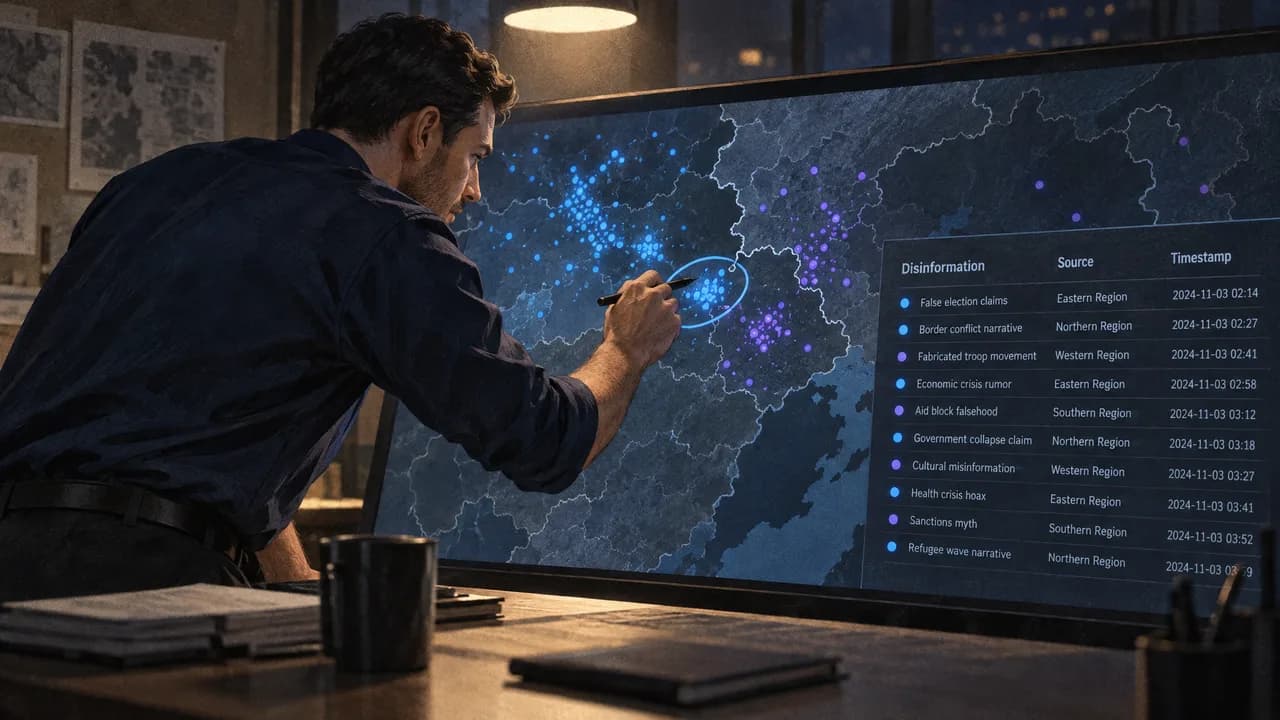
Information warfare for executives, explained plainly, is the use of information to alter what key audiences believe and how they decide, and it targets your credibility long before it touches your network. Most executives we meet have bought the wrong defense: they secure the firewall and ignore the fact that an attacker can weaponize their own digital footprint, their family's social media, or a decade-old court record against them. Information warfare does not need to breach your systems to damage you. It needs to change what your board, your customers, or the press believe about you.
The term sounds like a Pentagon specialty, and it is. But it has moved out of military doctrine and into the national press, and into the boardroom. Once you understand who runs these operations, what they are actually trying to change, and where your exposure genuinely sits, you can build a defense that holds. This piece walks you through the operating logic, the signals that distinguish a real threat from noise, and the sequence of moves that actually protect an executive's standing.
The Answer in Brief: Why Executives Must Learn This Now
Executives are the highest-value targets in information warfare because their credibility is a corporate asset. An attack on your judgment, your integrity, or your personal life is an attack on the share price, the partnership pipeline, and the talent you are trying to recruit. The attacker does not need to prove anything true. They need to make the allegation sticky enough that the denial becomes the story.
The reason this matters more in 2026 than it did a decade ago is that the tools have democratized. Coordinated bot networks, deepfake audio, and data broker archives are available at a cost that a disgruntled ex-employee, a competitor, or a hostile activist can absorb. Information warfare has become so mainstream that aspects of it are now reported in the national press as routine business events. When the tactic is common enough to be a news cycle, it is common enough to be aimed at you.
What This Term Actually Means
Information warfare is the use of information itself as a weapon: collecting it, distorting it, suppressing it, or flooding the environment with it, to change what people believe and how they act. It is not cyberwarfare, though the two overlap. Cyberwarfare attacks systems and data; information warfare attacks perception and decision-making. A distributed denial-of-service attack that takes a website down is cyberwarfare. A coordinated campaign that makes your customers believe your product has a safety flaw, seeded through forums, review sites, and planted news stories, is information warfare.
The formal definition is worth holding onto because it explains why conventional defenses fail. Information warfare takes place within the "information environment," defined as the aggregate of individuals, organizations, and systems that collect, process, disseminate, or act on information. That definition comes from academic and military literature, and it matters because it tells you the battlespace is not your server room. It is every review site that ranks your company, every data broker selling your home address, every forum where a former employee vents, and every journalist who searches your name before a story. ➀
For an executive, this reframes the threat model. The attacker is not trying to steal your password. They are trying to control the information environment around your name so that when a decision-maker researches you, they find what the attacker wants them to find. This is precisely the layer our executive digital protection practice is built to defend. We treat your reputation as an intelligence asset and apply the same collection and analysis discipline to protecting it that others use to attack it.
Understanding this distinction changes where you spend money. A penetration test validates your technical perimeter. It tells you nothing about whether a coordinated smear campaign is quietly ranking negative content about you on page one of search results. The competencies required to lead a technical security program, studied extensively in the cybersecurity leadership literature, are simply not the same competencies required to lead an information defense. One protects infrastructure; the other protects trust. ➁
What to Look For
When you evaluate any defense against information warfare, whether internal capability or an external partner, you need criteria that separate genuine protection from performative monitoring. Most offerings in this space sell one slice and call it coverage. Here is what to look for across the dimensions that actually matter. ➂
- Detection coverage: Does the service monitor the places where information warfare actually plays out, including data broker listings, people-search sites, social media, forums, and the dark web where attack plans are often assembled? A service that only watches your brand mentions misses the quiet phase where the attack is being built.
- Response capability: Detection without response is just a report that makes you anxious. Can the service suppress negative content, push down damaging listings, and remove your personal data from broker inventories? The answer to a smear is rarely a rebuttal; it is making the attack harder to find.
- Continuity model: Information is not a static asset. Data brokers re-list profiles after removal, which means a one-time cleanup is a temporary fix. Look for a service that operates on a re-scan schedule and treats removal as an ongoing process, not a project with an end date. The re-listing trap erodes one-time cleanups within months, which is why the operational model matters as much as the initial sweep.
- Human judgment: Automated tools flag anomalies, but they do not understand context. A single negative review on an obscure site may be noise; a coordinated cluster of similar complaints appearing simultaneously across platforms is a pattern. The difference requires a human analyst who understands information warfare tradecraft.
When a vendor cannot articulate what happens after the initial scan, walk away. You are not buying a snapshot; you are buying sustained denial of your attacker's preferred terrain.
The Step-by-Step Approach
A working defense against information warfare follows a sequence where each phase feeds the next. Skip a phase and the whole structure weakens.
Map your exposure. Before you can defend your information environment, you have to know what is already in it. This means a systematic audit of every data broker holding your personal information, every people-search site listing your address and family members, every social media account in your name or bearing your likeness, and every forum or review platform where your name has ever appeared. This includes your spouse and children. Attackers routinely exploit the least-protected family member to reach the executive.
Remove what can be removed. Once the map is complete, you file opt-out and deletion requests against every broker and listing site identified. This is the suppression phase, and it is the foundation of everything that follows. If your personal data is not already sitting in a broker's database, an attacker cannot buy it cheaply to build a targeting profile on you. We pair our monitoring with suppression of personal data from data brokers, the raw inventory an attacker draws on to build a target profile.
Monitor the environment continuously. Removal is not a finish line; it is a maintenance state. Data brokers re-list, new sites appear, and old court records get digitized and syndicated. Continuous monitoring watches for new exposures and, more importantly, for the early signals of a coordinated campaign: a sudden cluster of negative mentions, a spike in profile views on a dating site you never joined, or a new domain registered that mimics your company's name.
Build positive content depth. A reputation that exists only as a thin veneer of search results is easy to topple. A reputation backed by a deliberate body of positive content, thought leadership articles, speaking engagements, third-party coverage, and professional profiles, is structurally harder to damage. When an attacker tries to push negative content up the search rankings, they are competing against a deep bench of favorable material. This is the amplification phase, and it is the piece most self-managed defenses omit entirely.
Prepare the response protocol. You do not want to be drafting your crisis response while the attack is already live. Decide in advance who speaks for the company, what the legal thresholds are for takedown requests, and when an incident escalates from nuisance to a full information-operations response. The moment a coordinated attack is confirmed, the response window is measured in hours. Our dedicated Digital Guard is assigned per client and bridges reputation management with cybersecurity, so the person monitoring your exposure is the same person coordinating the response.
When to Act
You do not need to wait for a confirmed attack to justify building this defense, and you should not wait for one. The signals that indicate you are already in someone's crosshairs are usually visible before the actual strike lands.
Act immediately if you see any of these: a sudden and unexplained spike in negative reviews across multiple platforms within a short window; a journalist calling about a story that references information you know to be false or distorted; a cluster of new social media accounts using your name or your company's name with slight variations; or a data broker listing for you that includes information you never provided to that service. Any one of these can be coincidence. Two or more in the same quarter is a pattern.
The cheaper and wiser moment to act is before any of those signals appear. Executive protection is an insurance decision. You buy it because the cost of the premium is trivial compared to the cost of the event. If you are in a visible role, if your company is public, if you are involved in litigation, regulation, or competitive markets, you are already a target. The question is not whether someone will map your information environment. The question is whether you will have made that map useless to them before they finish.
When the attack is already underway, act within hours, not days. The first narratives to appear in search results tend to stick because they get indexed, quoted, and amplified before corrections can catch up. Once a false story has been picked up by syndicators, suppression becomes exponentially harder.
Common Mistakes to Avoid
The most expensive error executives make is classifying information warfare as an IT problem. They route it to the CISO, who runs a vulnerability scan and reports that the network is clean. The attack has nothing to do with the network. It is happening in a journalist's inbox, a prospect's search results, and a board member's Twitter feed, and the CISO has no mandate, and often no toolkit, to operate there. The attack succeeds because it was filed in the wrong department.
A subtler failure is treating a single cleanup as complete protection. An executive pays for one data broker removal, watches the most visible listings disappear, and declares victory. Six months later, the brokers have re-listed the profiles, and a new people-search site has syndicated the old data from a public records aggregator. The executive discovers this when a reporter calls, not when the monitoring service alerts them, because they cancelled the monitoring after the first sweep looked successful.
Then there is the instinct to fight the attack on the attacker's terms. A false allegation appears, and the executive drafts a detailed rebuttal, names the accuser, and demands corrections. That rebuttal feeds the algorithm. Controversy drives engagement, engagement drives ranking, and the rebuttal ends up as the second result under the original smear, cementing the false story's visibility. The disciplined response is often silence plus suppression: starve the narrative of oxygen while pushing the positive content depth that buries it.
The final mistake is ignoring the human cost and reading everything as a technical anomaly. An information attack is designed to provoke. It wants the executive to respond emotionally, to fire someone prematurely, to make a public statement that extends the news cycle. The executives who navigate these campaigns intact are the ones who recognize the provocation for what it is and refuse to let the attacker dictate the tempo.
Related reading
Frequently Asked Questions
Can you give me some examples of information warfare?
A competitor funds a coordinated review campaign that floods your product pages with near-identical negative ratings. A former employee with access to internal documents leaks selectively edited emails to a journalist to suggest misconduct. An activist group creates a deepfake audio clip of your CEO making inflammatory remarks and circulates it before it is debunked. Each example shares a structure: information is collected, distorted, and disseminated with the intent to change what a target audience believes about you.
What are the four types of warfare?
A common academic framing distinguishes cyberwarfare, which attacks systems and data; electronic warfare, which attacks the electromagnetic spectrum; psychological operations, which target enemy morale and decision-making; and military deception, which feeds false information to shape an adversary's actions. In the corporate context, executives most often face psychological operations and deception, adapted for commercial and reputational targets rather than battlefield objectives.
What are the five pillars of information operations?
The five pillars are typically listed as psychological operations, military deception, operations security, electronic warfare, and computer network operations. These emerged from military doctrine but map directly onto corporate threats. Psychological operations become smear campaigns; deception becomes planted false narratives; operations security becomes protecting executive communications; computer network operations become the hacking of personal accounts. Recognizing this structure helps you identify which pillar an attack is using.
Why has information warfare become more relevant for business leaders?
Information warfare has moved from a niche military discipline into mainstream awareness, with its tactics reported in national press coverage of corporate and political events. The tools that once required a state intelligence budget, data aggregation, bot networks, synthetic media, are now available at commodity prices. When the barrier to entry drops this far, the threat stops being hypothetical and becomes a routine business risk that warrants routine mitigation.
How is information warfare different from ordinary public relations?
Public relations builds and maintains reputation through truthful, controlled messaging. Information warfare is indifferent to truth and seeks to control the information environment through collection, distortion, and suppression. PR assumes goodwill and operates within ethical boundaries. An information attack assumes neither, and it will exploit gaps in your digital footprint, your family's exposure, or your company's public records that PR never touches. Defending against it requires security tradecraft, not just messaging.
Sources
- ➀ jsis.washington.edu
- ➁ Wagner et al., European Conference on Cyber Warfare and Security
- ➂ Concepts in information warfare. Information Warfare
Sources checked on September 5, 2026.
Get new articles by email
New articles from Area 52, sent to your inbox.
By subscribing you agree to receive emails from Area 52 about new articles. You can unsubscribe at any time.