External Vulnerability Scans Are Only as Good as the Gap Between Them
Use this to set a scan interval that fits how fast exploited flaws pile up, and to decide who owns the asset list, triage and rescans after each run.
By the Area 52 team
6 min read
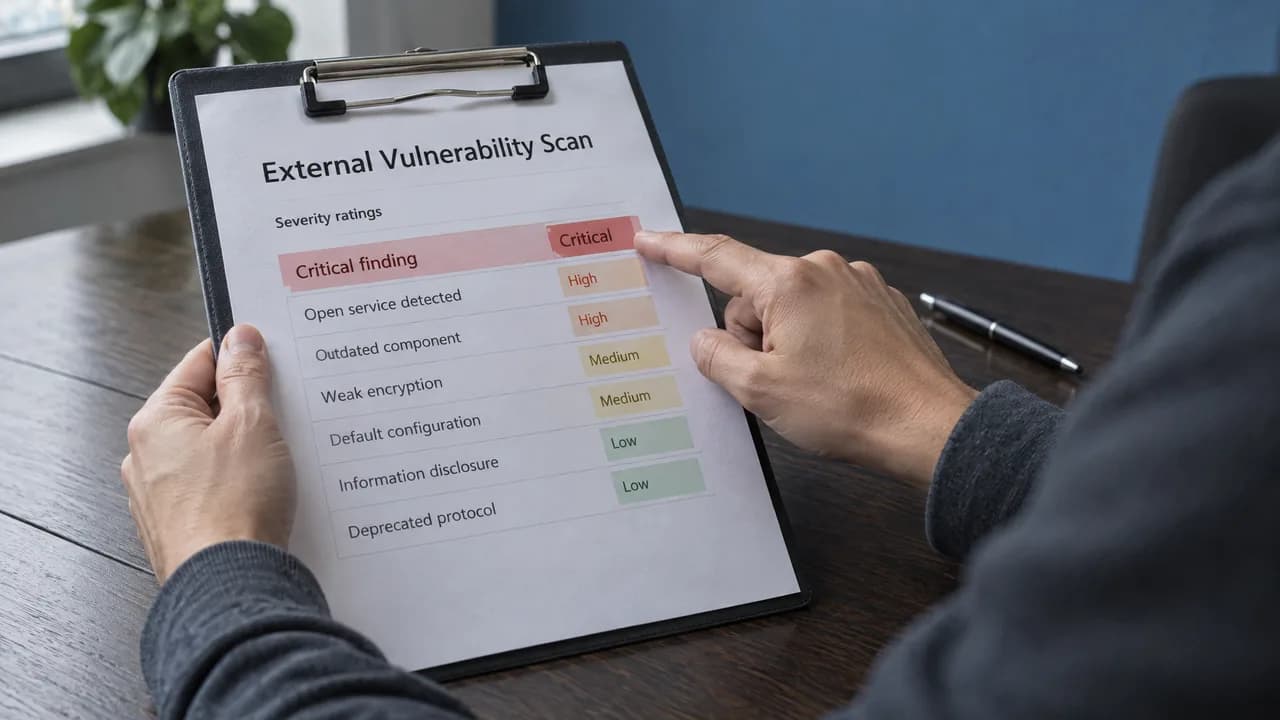
An external vulnerability scan probes your internet-facing systems from outside your network, the way an attacker would, and reports the exposed services, outdated software and known flaws it can reach without credentials. The report is a timestamp, not a status. Its value is set by how soon the next run happens, because the list of flaws attackers are using keeps growing after the scanner goes quiet.
What an Outside-In Scan Touches, and What It Never Sees
The scanner starts from a target list: IP ranges, hostnames and domains you hand it. It probes those addresses for open ports, then fingerprints whatever answers by reading service banners, TLS certificates and software versions. Each fingerprint is matched against records of known vulnerabilities, and the matches come back ranked by severity. No login, no agent on the host. That is the design: an unauthenticated run sees what an anonymous stranger on the internet sees.
That design produces two failure modes you should understand before trusting a clean report. Version matching is inference. A server that reports an old version string but carries a backported patch gets flagged anyway, while a service that hides its banner can slip through untested.
Scope is the bigger blind spot. The scanner checks only what is on the list, and attackers do not use your list. A marketing microsite on a forgotten subdomain, a vendor-hosted login page, a test server someone opened for a weekend: none of them appear in the report if nobody added them.
Of all the types of vulnerability scans, the external run is the only one that shares the attacker's vantage point. Internal scans start inside the network, usually with credentials, and answer a different question. The reference data moves too: CISA's Known Exploited Vulnerabilities (KEV) catalog grew from 1,239 vulnerabilities at the end of 2024 to 1,484 at the end of 2025, an increase of just under 20%. A host that matched nothing in January can match in June without a single change on your side. What scanning tools do once a match lands is a separate decision, and it matters as much as detection.
Running the Check on a Cadence Attackers Cannot Outpace
- List every internet-facing asset before scanning anything: domains, subdomains, cloud addresses, remote-access gateways and portals that vendors host on your behalf. The scan inherits every gap in this list.
- Get written authorization for each target, including third-party hosting, because probing a system you do not control can breach the provider's terms.
- Run unauthenticated from outside your perimeter. Where card data is in scope, the PCI Security Standards Council defines an Approved Scanning Vendor (ASV) as an organization with security services and tools to conduct external vulnerability scanning that validates adherence with PCI DSS Requirement 11.3.2.[2] (PCI Security Standards Council)
- Triage by exploitation, not by severity score alone. A medium finding that sits on the KEV catalog deserves your engineers before a critical one nobody is attacking.
- Fix, then rescan the same target to confirm the finding closed. A ticket marked done is not a closed port.
- Rerun on a fixed interval and after every change to DNS, firewall rules or hosting, then compare the new asset list against the last one. New exposure often arrives as a new asset rather than a new flaw on an old one.
Free scanning tools can execute steps three and five. The steps that decide whether a scan protects anything are one, four and six, and those are judgment calls that need an owner.
The Numbers That Set the Interval
A vulnerability scanner, by definition, compares what it finds against a catalog of known flaws, so its output is only as current as that catalog and the date of the last run. The timing data explains why the date matters. CISA's guidance on securing high value assets cites a study that sampled 50,000 organizations: at approximately 40 to 60 days from a vulnerability's release, the probability that it would be exploited is around 90%. A quarterly scan leaves a window wider than that.
The catalog is also getting busier. Growth accelerated in 2025, when CISA added 245 vulnerabilities to the KEV catalog, more than 30% above the trend seen in 2023 and 2024.[1]
Old findings join the catalog too. “In 2025, the number of vulnerabilities from 2024 and earlier added to the catalog grew to 94, a 34% increase from a year earlier” (Cyble (analysis of CISA KEV catalog data)). A finding your team accepted as low risk last year can turn into an actively exploited one this year. If nobody rescans and re-triages, the acceptance stands on stale evidence.
The other side runs at machine speed. Microsoft's Digital Defense Report 2025 says the company blocks approximately 4.5 million new malware attempts daily. A scan triggered by a calendar reminder competes with that volume.
The same decay applies to leaked credentials, which is why we treat a one-off Aura dark web scan as a snapshot rather than coverage.
Where Area 52 Takes Over the Outside View
Vulnerability scans are part of Overwatch, our managed package, alongside content creation, amplification, suppression, data broker removal, dark web monitoring and positive reviews. Our ethical hackers scan your website for vulnerabilities and notify you when found, so you can close them and harden your system. Every engagement is tailored to the client. Overwatch comes with a dedicated Digital Guard, so the package has a named person attached rather than a dashboard nobody opens.
For executives, the attack surface does not stop at the corporate perimeter. Home addresses, phone numbers and family records sold by data brokers hand an attacker the same reconnaissance an external scan is meant to deny. That is why we suppress personal data from data brokers inside the same package. We combine reputation management with cybersecurity because both are exposure sitting in public view.
Real-time threat response belongs to our 24/7 SOC. If your last external report is older than your last infrastructure change, it describes a network you no longer run. Email greyman@a52.io or call 571-210-2227 to scope a recurring sweep.
Frequently Asked Questions
What are the two types of vulnerability scans?
The usual split is external and internal. An external scan runs from the internet against your public-facing addresses and shows what an outsider can reach. An internal scan runs from inside the network, often with credentials, and finds missing patches, weak configurations and paths an intruder could use after getting in. A second split, authenticated versus unauthenticated, describes whether the scanner logs in. External runs are almost always unauthenticated, which is why they reflect the attacker's starting position rather than your administrator's.
What is an example of a vulnerability scanner?
An Approved Scanning Vendor's scan solution, used for PCI external scanning, is one example. Network scanners that probe ports and services, and web application scanners that test sites and forms, are others. The category matters less than two properties: whether the tool's vulnerability data updates continuously, and whether it discovers assets from the outside or only scans the list you typed in. A scanner that never learns about a forgotten subdomain will report it clean indefinitely.
Is an external vulnerability scan the same as a penetration test?
No. A scan matches what it observes against known flaws and reports likely matches; it does not try to break in. A penetration test puts a person on the problem, attempting to exploit findings, chain weaknesses together and confirm what an attacker could reach. The scan tells you where to look, and the test tells you what that exposure is worth to an adversary. At Area 52, vulnerability scans sit inside Overwatch while penetration testing is a separate service, so each is scoped to the question it answers.
Sources
- Cyble (analysis of CISA KEV catalog data)
Overall, CISA KEV vulnerabilities grew from 1,239 vulnerabilities at the end of 2024 to 1,484 at the end of 2025, an increase of just under 20%.
- PCI Security Standards Council
An ASV is an organization with a set of security services and tools (“ASV scan solution”) to conduct external vulnerability scanning services to validate adherence with the external scanning requirements of PCI DSS Requirement 11.3.2.
- Microsoft Digital Defense Report 2025
Cybercrime at scale: the Numbers behind the threat Microsoft processes over 100 trillion signals daily, blocks approximately 4.5 million new malware attempts, analyses 38 million identity risk detections, and scans 5 billion emails for malware and phishing threats.
Sources checked on November 25, 2026.
Get new articles by email
New articles from Area 52, sent to your inbox.
By subscribing you agree to receive emails from Area 52 about new articles. You can unsubscribe at any time.