Strategic Information Warfare Belongs to a Standing Team, Not a Crisis
Strategic information warfare is not a campaign you launch. It is a standing collection and suppression operation, and the organizations that treat it as a purchase order instead of a discipline pay for the difference twice.
By the Area 52 team
11 min read
Strategic information warfare is a permanent collection and counter-influence operation that a dedicated team runs against a defined adversary set, not a communications campaign you switch on after a story breaks. The distinction costs money either way, but it costs far more to learn it late. Most organizations buy the campaign and then wonder why the same names keep surfacing on the same search pages two quarters later.
The Short Version: It Is a Standing Operation, Not a Campaign
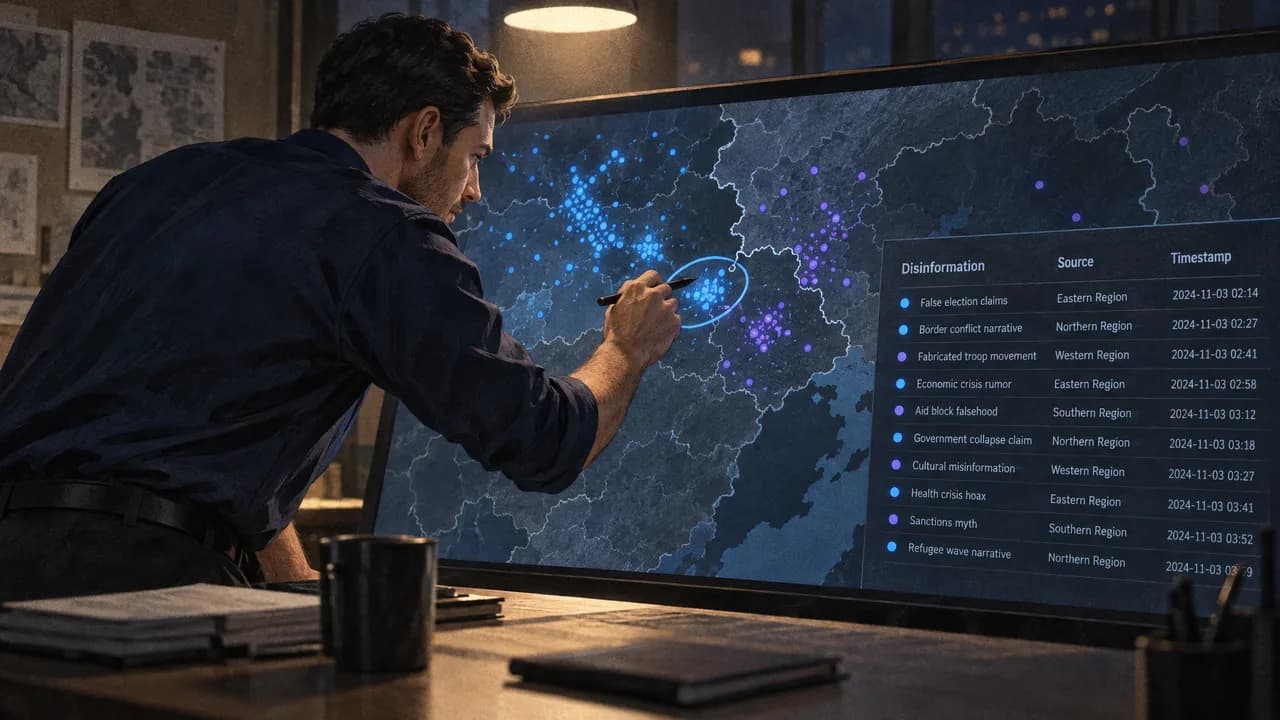
The work splits into two halves that share one team and one picture of the target. One half collects: it gathers what is being said about your executives, your subsidiaries, your litigation, and your key hires, and it maps who is saying it and why. The other half acts: it suppresses what should not be publicly rankable, amplifies what should, and files the removal requests that take personal records off broker inventory.
The reason this has to be continuous is that the adversary's timeline does not pause when your budget cycle ends. A leaked internal email, a former employee with a grievance, a short seller building a position, or a competitor's PR firm all operate on their own schedule. If your first look at the landscape happens the morning after publication, you are not running an operation. You are running a cleanup.
We take the position that the dedicated outside team is the right structure for most organizations, and the reason is unglamorous. In-house teams cannot collect impartially on their own leadership, because the people doing the collecting report to the people being collected on. That structural problem does not get fixed with a bigger security budget.
What the Term Covers Once You Strip the Doctrine
Strip away the military vocabulary and the definition sharpens considerably. Information warfare takes place inside what analysts call the information environment, defined as the aggregate of individuals, organizations, and systems that collect, process, disseminate, or act on information per the University of Washington Jackson School. That definition matters because it kills the assumption that this is only about media coverage. The environment includes your recruiting pipeline, your vendor relationships, your investors' group chats, and the AI models that now answer questions about your company without citing anyone.
Who it serves is narrower than the phrase suggests. This discipline is built for organizations whose leadership is individually identifiable: public companies, founder-led firms, funds with named partners, family offices, and any business whose CEO's name is a search term. A company with no named public face has far less surface to defend, and a general security program will usually cover it.
The definition that circulates in most board decks stops at the media layer, and that gap is what we would point you to if you want the long version of where the standard definition stops being useful. The practical difference: influence applied to a hiring decision, a supplier negotiation, or a loan covenant is the same discipline aimed at a different target, and the collection apparatus looks almost identical.
How the Machine Actually Runs
The mechanism is a loop, and every stage feeds the next one. Break any link and the whole thing degrades into a clipping service.
Collection runs first and never stops. Analysts pull from public records, broker listings, social platforms, forum chatter, paste sites, and the commercial breach market. The output is not a report; it is a continuously updated picture of what is exposed and who is paying attention to it. The important part is the correlation step, where an analyst links an obscure forum mention to a named executive to a pending transaction. Individually, each item is noise. Stacked, they describe an intent.
Verification comes next, and it is where amateur operations collapse. A threat that turns out to be a competitor's routine press push, or an old cached page, burns credibility with the executive who has to act on it. Every item that reaches a decision maker should carry its source, its reliability, and its shelf life.
Analysis turns verified items into a decision: suppress, monitor, or pre-position a response. This is the stage that requires judgment rather than tooling, and it is the reason a software subscription alone never solves the problem. Someone has to decide that a specific piece of content is worth the cost of suppressing rather than the risk of drawing attention to it.
Action executes the decision. Suppression pushes unflattering or inaccurate material down the ranking curve and out of AI answer sets. Amplification builds the positive record that occupies the space instead. Data broker removal attacks the underlying inventory. Vulnerability scans and penetration testing close the technical doors that let an adversary walk into the same building through a different entrance. The two halves of our own practice, reputation work and security work, sit in this stage together because they are aimed at the same adversary through different surfaces.
If you want the plain-language version of how the collection and influence layers fit together before you go deeper, the plain-language briefing on what this discipline covers is the shorter path. And a pattern that shows up across recent campaigns is worth reading for the sequencing, because the order in which an adversary releases material tells you more about intent than the material itself.
The loop then closes. Every action produces new signal, which re-enters collection, which adjusts the picture. An operation that does not re-scan after it acts is not an operation. It is a press release.
Running It Without Freezing the Business
The model here is a standing function with a defined cadence, not a project with a kickoff and a closeout. The steps are sequential because each one's output genuinely gates the next.
- Define the protected set. Name the executives, family members, entities, and addresses in scope. Be specific, because a vague scope produces vague collection.
- Establish the baseline. Run a full exposure sweep across public records, broker inventory, breach data, and search surfaces to see what is already visible before anyone tries to change it.
- Set the collection cadence. Standing monitoring against public sources, with alerting thresholds tied to the protected set. This is the layer that most organizations outsource first.
- Triage and verify. Every alert gets a source, a reliability rating, and a decision. Alerts without decisions are noise with a subscription fee.
- Execute suppression and removal. Push down what should not rank; file removal requests against broker records; close technical exposures surfaced by scans and testing.
- Re-scan and measure. Confirm the material actually stayed down, because listings reappear and cached copies resurface under new URLs.
Standing collection against public sources is the piece most organizations underestimate, and the practical guide to running it covers the tooling and cadence side in more depth than a step list can.
The cadence itself should be dull. Daily automated monitoring, a weekly analyst review, a monthly executive summary that fits on one page. The moment the reporting cadence depends on someone remembering to run it, the operation is already dead and nobody has noticed yet.
The Dimensions That Separate Serious Operations From Theater
Every provider in this market will show you a dashboard. What separates them is whether anything underneath the dashboard changes.
| Dimension | What to look for |
|---|---|
| Collection breadth | Sources beyond news: records, broker inventory, breach markets, forums, and the AI answer layer |
| Verification discipline | Whether items are labeled with source and reliability, or forwarded raw |
| Attribution and continuity | A named person who knows your account and stays on it, not a rotating pool |
| Action capability | Whether they can suppress, remove, and remediate, or only report |
| Re-scan behavior | Proof that removal attempts are verified afterward, not just filed |
| Measurement | Metrics tied to exposure reduced, not impressions delivered |
The row most buyers skip is the last one. Coverage metrics built on volume of mentions tell you how loud the environment is, not whether your exposure went down. If the reporting cannot show a specific listing that existed last quarter and does not exist now, the report is decoration.
Continuity deserves its own note because it is invisible in a demo. A privacy protection service is only as good as the operator assigned to it, and an account that changes hands every two quarters loses the accumulated context about which adversaries matter, which assets are sensitive, and which past actions actually held. Ask how the account is staffed before asking what the dashboard does.
Repeatability is the other dimension that never makes it into an RFP. Removal is not deletion, so the same record can reappear weeks after a successful request, and the operator has to be watching for it. Why removal work has to be repeated is the section of this market that most buyers only learn about after their first re-listing.
Where Experienced Teams Still Lose Ground
Treating the whole thing as a purchase. A contract, a dashboard, and a kickoff call feel like progress. They are not. Organizations that buy the artifact and skip the rhythm are the ones surprised by an item that sat in plain sight for six weeks.
Letting the collection team report to the people it collects on. This is the structural failure that in-house programs cannot engineer away. The security lead who has to brief the CEO about a hostile mention of that same CEO's personal history will soften the item, delay it, or bury it in an appendix, and every one of those choices compounds. An outside team with a named Digital Guard assigned to the account can say the uncomfortable thing because the reporting line does not punish honesty.
Confusing volume with exposure. Reports that count mentions rather than track specific records create a false sense of coverage. The useful question is not how much was found this month. It is which specific items were removed, which are pending, and which new ones appeared against the protected set.
Publishing the counter-narrative too early. Reacting to a negative item on day one puts it in front of audiences that never saw it. Suppression works best as quiet displacement over weeks, and a loud rebuttal is often the adversary's preferred outcome because it converts a low-traffic item into a widely read one. The discipline here is patience, and it is genuinely hard for executives who are used to answering fast.
Running it as a compliance exercise. If the program exists to satisfy a checklist rather than to change what a counterparty can find about your leadership, the adversary does not care that the boxes are ticked.
Deciding Whether Your Organization Needs This Now
You face a specific question: do you stand up a protected-set operation before an incident, or after? There is no free option. Standing it up later costs more and recovers less, because the adversary's material has already been indexed, cached, and absorbed into the AI answer layer by the time you start.
Look for signals rather than waiting for a breach. A named executive with a public profile and a personal address findable in three searches is signal one. A transaction in progress, funding round, acquisition, or litigation is signal two, because those windows attract attention. A sudden change in the tone of search results around a leader's name, or the appearance of a domain that mimics your corporate one, is signal three. Finally, an executive with a documented prior breach and reused credentials is signal four, and it is the one most often ignored because the incident was handled and closed.
Your decision is not really buy or don't buy. It is build, pivot, or abandon. Building in-house works only when the collection team sits outside the reporting line of the people it watches, which is rare and hard to maintain. Pivoting works for organizations that already have monitoring but no action capability: keep the collection and add the suppression and removal layer rather than starting over. Abandoning is correct when there is no named public face and the threat model is purely financial fraud, and in that case a conventional security program is the better spend.
Where those signals are present and the internal reporting line is compromised, we would run it with a dedicated outside team, and we would say so knowing it is more expensive than a subscription. The trade-off is real: an outside team knows less about your business at the start and needs a ramp period to learn which assets matter. What it buys back is impartial reporting, cross-client pattern recognition, and the ability to say the uncomfortable sentence in the room. That is the whole case for the structure.
If your situation matches those signals, the next step is a conversation about scope and what a protected set would look like for your organization, not a product demo. Reach out to us and we will walk the exposure before we talk about anything else.
Frequently Asked Questions
What are some examples of information warfare?
The examples worth studying are rarely the spectacular ones. A competitor seeding forum posts about a rival's liquidity ahead of a funding round, a coordinated negative review push timed to a product launch, leaked internal emails released in a sequence designed to extend the news cycle, and impersonation attempts against a named executive's personal accounts all qualify. What ties them together is a target, a crafted narrative, and a release schedule. The release order usually reveals intent more clearly than the content.
What are the 7 phases of unconventional warfare?
Unconventional warfare doctrine moves through seven stages: preparation, initial contact, infiltration, organization, buildup, combat operations, and demobilization. The framing is military, but the early stages map cleanly onto what happens in corporate information campaigns. Preparation and infiltration happen long before the target notices anything, which is exactly why collection has to run continuously. By the time the equivalent of open conflict begins, the adversary has usually spent months positioning material and relationships.
What does strategic warfare mean?
Strategic denotes the level at which the objective is decided, not the volume of activity. Strategic warfare is directed at an adversary's will and capacity to continue, in contrast to tactical actions aimed at immediate local effects. In the information domain, that means a campaign designed to change how decision makers, investors, or regulators regard your organization, sustained over months, rather than a single press response. The level of the objective, not the size of the effort, is what makes it strategic.
What are the four levels of warfare?
The four levels are strategic, operational, tactical, and the political or grand strategic level that sets the overall aim. Each level answers a different question: what outcome is wanted, how the campaign is sequenced, what happens in a specific engagement, and what the broader political objective is. Corporate information work mirrors that stack. The board sets the outcome, the program sequences the effort, the daily collection and removal work is tactical, and reputational standing with regulators and investors is the highest layer.
Get new articles by email
New articles from Area 52, sent to your inbox.
By subscribing you agree to receive emails from Area 52 about new articles. You can unsubscribe at any time.